

Design-Led Jewellery: The Artistry Behind Haute Joaillerie, With Graff
For designers, few disciplines are as exacting as haute joaillerie (meaning the highest tier in French). High jewellery must combine beauty with engineering, imagination with the physical properties of precious metals and stones, and grand ideas with a scale measured in millimetres.
Each piece can take hundreds or even thousands of hours to create, passing through the hands of many specialists before it is fully complete. Understanding that process reveals why high jewellery is regarded not simply as luxury, but as one of the great applied arts. Continue reading to learn more.
It Begins With A Drawing
Most high jewellery begins its journey as a hand-painted design, traditionally rendered in gouache on toned paper. These drawings are works of art in their own right. Designers use them to explore form, volume and the play of light on metal and stone, often painting each gem with remarkable precision. The drawing becomes the reference for every craftsperson who follows.
Graff: The Stone As Starting Point
Sometimes the design leads; sometimes the stone does. No house illustrates the second approach better than Graff. Founded in London in 1960 by Laurence Graff, it is a family-owned, vertically integrated jeweller that oversees its stones from the sourcing and cutting all the way through to design, manufacture and finally retail. This level of control allows the house to build pieces around exceptional diamonds, each stone’s character dictating the design.
Graff has been associated with some of the most remarkable diamonds of recent decades, including the Lesedi La Rona, at 302.37 carats, described as the largest high-colour, high-clarity diamond ever certified by the GIA. Yet its craft is just as evident in smaller pieces, where cutting and setting are executed with the same exacting standards.
From Two Dimensions To Three
Transforming a drawing into something wearable is undoubtedly a design challenge in its own right. Model makers start by creating a prototype in wax or metal to test proportions, articulation and comfort. For instance, a necklace needs to drape naturally, earrings must balance, and a classic ring has to sit comfortably on the finger. In today’s modern world, digital modelling very often works alongside traditional techniques, but the human eye still remains the final judge of quality.
The Craft Of Setting
The setting is where engineering and artistry meet. Techniques such as pavé, where small stones are set closely together to create a surface of light, or micro-pavé, using even tinier stones, demand extraordinary precision (anything less simply won’t cut it).
In the most highly celebrated invisible-setting techniques, stones are cut with grooves in order for them to slide onto fine rails, leaving no visible metal between them. Each different approach will change how light moves through a piece.
Finishing And Polishing
Before a piece can be considered “complete”, a polisher needs to work their magic and refine every surface, even areas that the wearer may never see. In high jewellery, the back of a piece is very often finished just as carefully as the more visible front. This attention to unseen detail is one of the clearest markers of true artisan craftsmanship.
Design That Moves
The most accomplished high jewellery will always be designed to come alive when worn (whether it is for a special event, or just simply relaxing at home).
Articulated links allow necklaces to follow the contours of the body, while pieces set on fine springs (known as en tremblant) will subtly quiver with each movement. Some creations are transformable, allowing a necklace to change into a bracelet or a brooch to be worn as a pendant. These innovations show how deeply design thinking runs through the discipline.
Time As A Material
Perhaps the most precious material in high jewellery is time. Even a single necklace may require months of work from designers, gemmologists, model makers, setters and polishers, each contributing a specialised skill developed over many years. This amount of patience is impossible to replicate at scale, and is the main reason that each piece carries a sense of unique individuality that mass production cannot achieve.
Not Only For Her
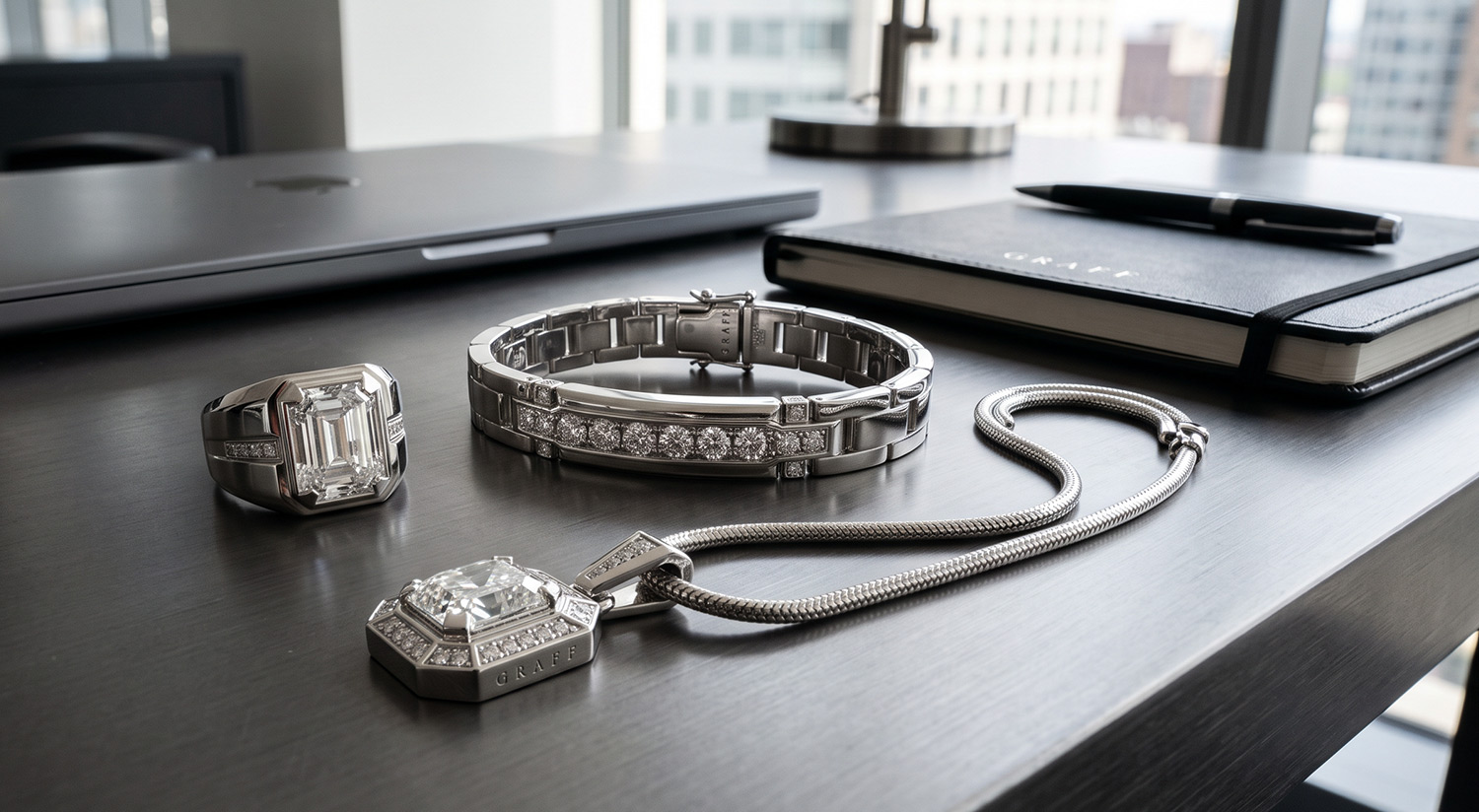
High jewellery is no longer the preserve of one audience. More men are appreciating fine jewellery for themselves, from diamond cufflinks to signet rings and refined bracelets (no longer just content with a simple watch, ring, or a plain cuff).
Additionally, many guys approach accessories as they would a fine watch: with an interest in craftsmanship, materials and provenance. It is also, of course, one of the most meaningful gifts a man can choose.
Why It Matters To Designers
For anyone with a strong interest in design, haute joaillerie offers lessons in restraint, proportion, and the relationship between form and material. It shows what is possible when craft is given time, and when every decision will serve the final experience of whoever is wearing the piece.
Graff is a name that is well known across the globe thanks to their extensive range of quality pieces. If you are a seasoned globetrotter (with an eye for stylish jewels), you can find stockists in luxury hotspots from New York to Dubai (where you can discover fine jewellery at Ahmed Seddiqi boutiques), or across Europe, in Paris or Geneva.
If you are searching for a new striking jewellery piece for your men’s wardrobe collection, you should seriously consider something from Graff, as the right investment will quickly elevate your fashion status no matter where your travels take you.
Thanks for reading my latest style article. Please let me know what you think in the comments section below.
